Validation
What it is, why it comes first, and how to read the report you get back
Validation is the part of PlanMySaaS that is allowed to tell you no. It researches your idea across up to 29 sections, scores each one, and ends with a verdict you did not write. This chapter explains what the machine is actually doing, how to read the result, and what to do when the answer is not the one you wanted. Every screenshot here comes from a real validated idea — UploadEze, a browser extension for fixing file uploads on Indian exam portals.
What validation is
Research with a verdict attached, run section by section.
Validation takes the idea you described and researches it the way a careful analyst would: who has this problem, how badly, how many of them there are, who already serves them, what it costs to reach them, what could kill the business, and what the numbers have to look like for it to work.
It does this as up to 29 separate sections rather than one long essay. Each section is generated on its own, scored on its own, and saved on its own. That matters more than it sounds: a weak section is visible as a weak section, and can be re-run without touching the 28 that were fine.
The result is a report with a score out of 100 and one of three verdicts — Build, Reconsider, or Do not build.
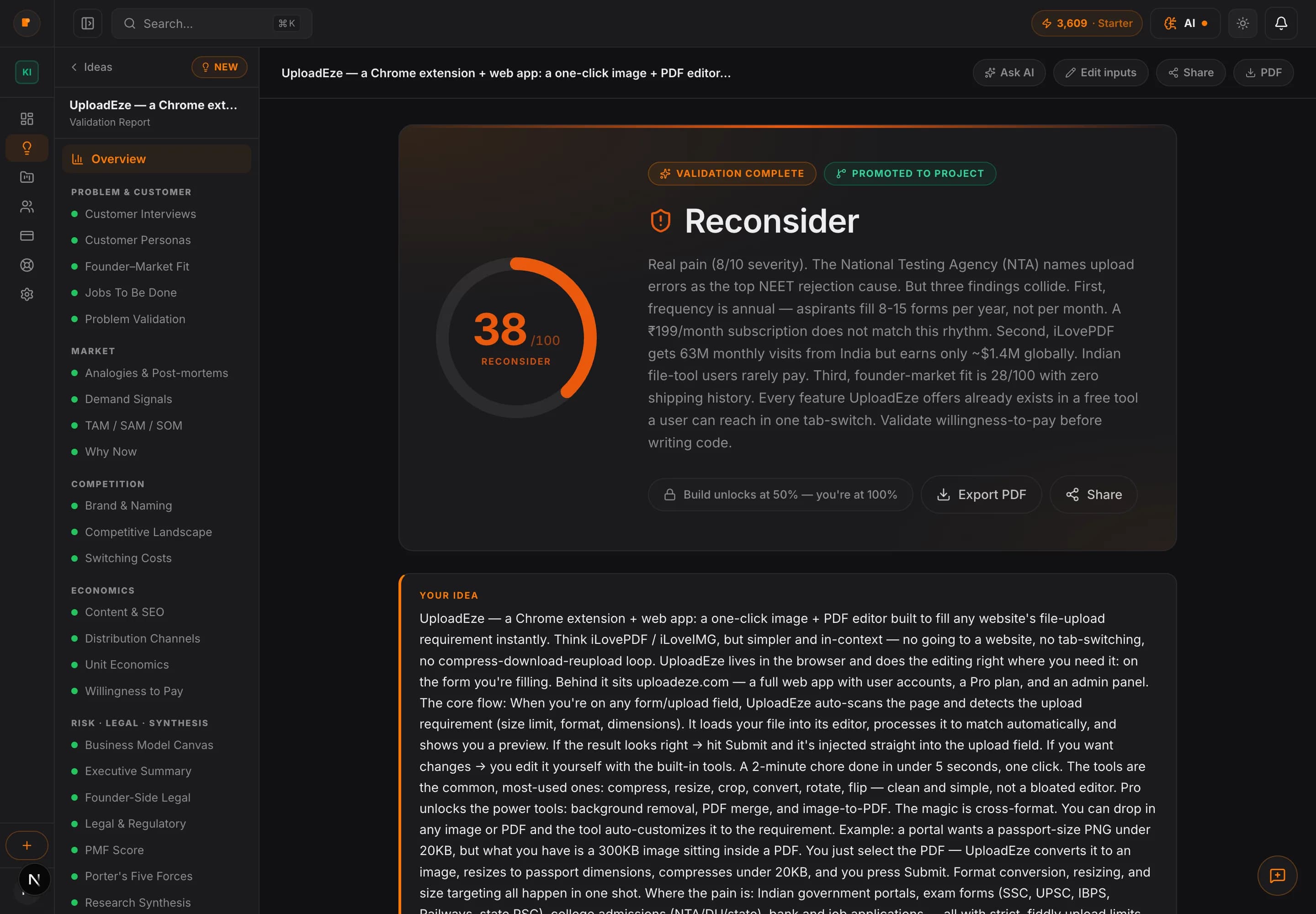
- 1The score and verdict — here 38/100 and RECONSIDER. This is the machine's answer, not a summary of yours.
- 2The reasoning paragraph names the specific findings that produced the verdict, with the numbers behind them.
- 3Section by section lists all 29 sections grouped into the five phases, each with its own quality score.
- 4Re-validate creates a new version. The original report is kept for comparison, never overwritten.
Why it comes before the blueprint
A worked example of validation earning its cost.
UploadEze scored 38 out of 100 and came back Reconsider. The idea was not dismissed — the research agreed the pain was real and rated its severity 8 out of 10, citing the National Testing Agency naming upload errors as the top cause of NEET rejection.
What it found was a collision between three facts. The pain is real but annual, not monthly, because an aspirant fills 8 to 15 forms a year — which does not fit a monthly subscription. iLovePDF gets 63 million monthly visits from India and earns roughly $1.4M globally, which says Indian file-tool users rarely pay. And founder-market fit scored 28 out of 100.
None of those three facts is obvious from the idea description. Each one costs a few credits to find and could cost months to discover by building. That is the whole argument for running validation first.
How a run works
Intake, five phases, one section at a time, then a verdict.
From a sentence to a verdict
The five phases
| Phase | Name | What it establishes |
|---|---|---|
| 1 | Problem & customer | Whether the pain is real, who has it, how badly, and whether you are the right person to fix it |
| 2 | Market | How many of them there are, whether demand is visible today, and why now rather than five years ago |
| 3 | Competition | Who already serves this need, how hard it is to switch away from them, and whether the name is usable |
| 4 | Economics | What customers will pay, what it costs to serve and reach them, and which channels actually work |
| 5 | Risk, legal and synthesis | What could kill it, what the law requires, and the verdict that pulls all of it together |
Reading one section
What is on a section page and which parts you can act on.
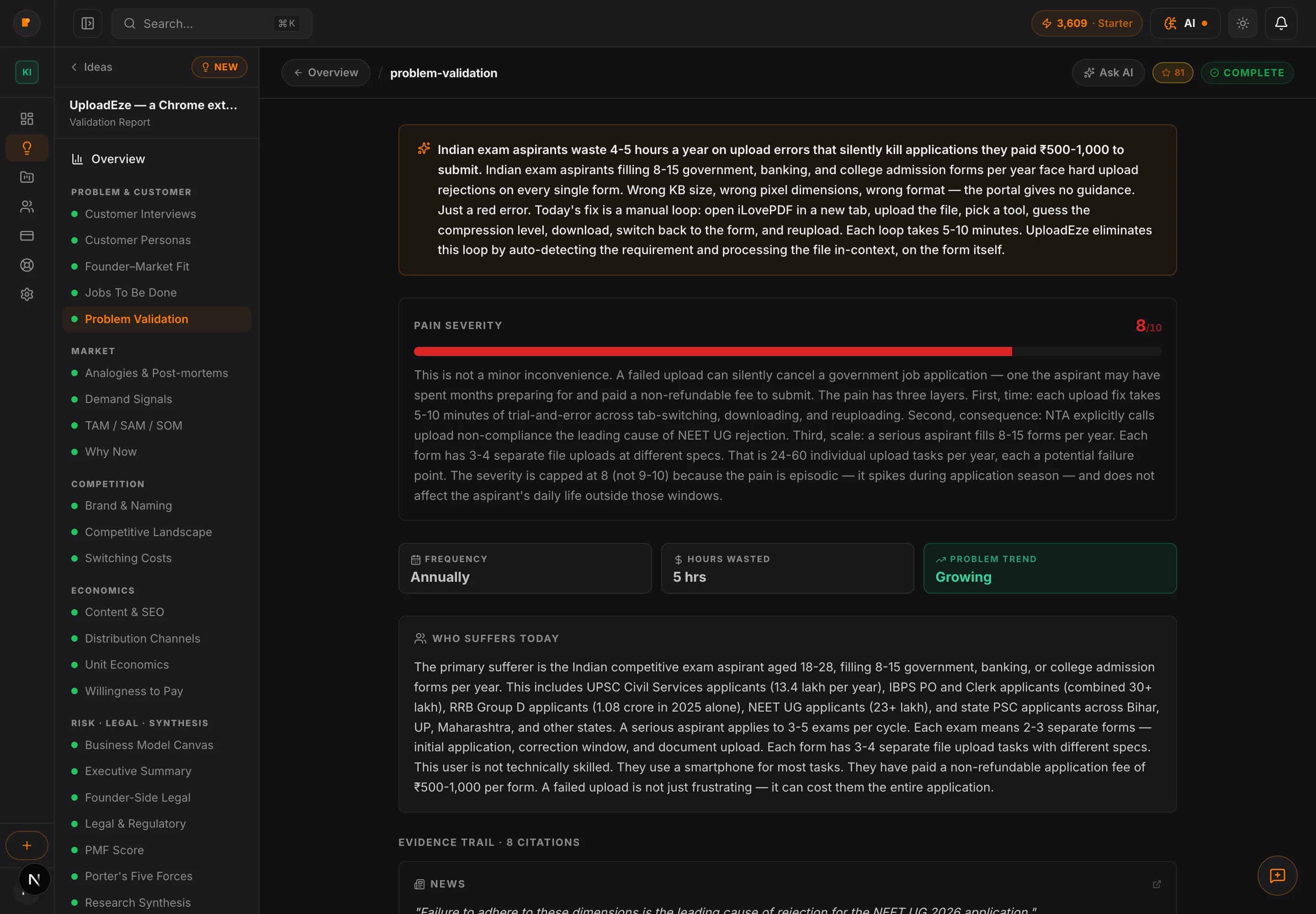
- 1The quality score (81) and status (Complete) tell you how well-supported this section is.
- 2The opening paragraph is the finding in one breath — read this first, then decide whether you need the detail.
- 3Structured fields like Pain severity 8/10 and Frequency: Annually are what synthesis sections later read.
- 4Ask AI opens a conversation about this section specifically, not about the whole idea.
Sections are not free text. Each one produces named fields — a severity, a frequency, a list of personas, a set of channels — and those fields are what later sections consume. That is why a section can be strong on prose and still score badly: the score reflects how well the evidence supports the fields, not how well it reads.
Quality scores, and what they are not
The number next to a section measures the research, not the idea.
Every completed section carries a score. In the UploadEze report most sections sit between 74 and 85, with Content & SEO Landscape at 41 and Competitive Landscape at 59.
A low section score does not mean the idea is bad in that dimension. It means that section's output is thinly supported — the research found less than it wanted, or the evidence it did find was weak. The right response is to read that section first, not to average the numbers.
The verdict score at the top of the report is a different number. That one is about the idea.
| Number | What it measures | What to do with it |
|---|---|---|
| Section score (0–100) | How well-supported this section's findings are | Open anything below 70 and read the evidence yourself |
| Verdict score (0–100) | How strong the idea looks once every section is weighed | Use it to decide whether to build, test more, or change the shape of the idea |
| Status pill | Whether the section finished, failed, or was skipped | Re-run failed sections; skipped ones were not part of your tier |
Changing your inputs and re-validating
How to update a report without losing the one you have.
Ideas move. When your description or your intake answers change, the report that was true last month is quietly stale.
Re-validate creates a new version of the report. The previous version stays saved and readable, so you can compare what the research concluded before and after your change. Nothing is overwritten.
If only one section is wrong, re-run that section instead. It costs a fraction as much and leaves everything else untouched.
Promoting to a project
The moment validation ends and planning begins.
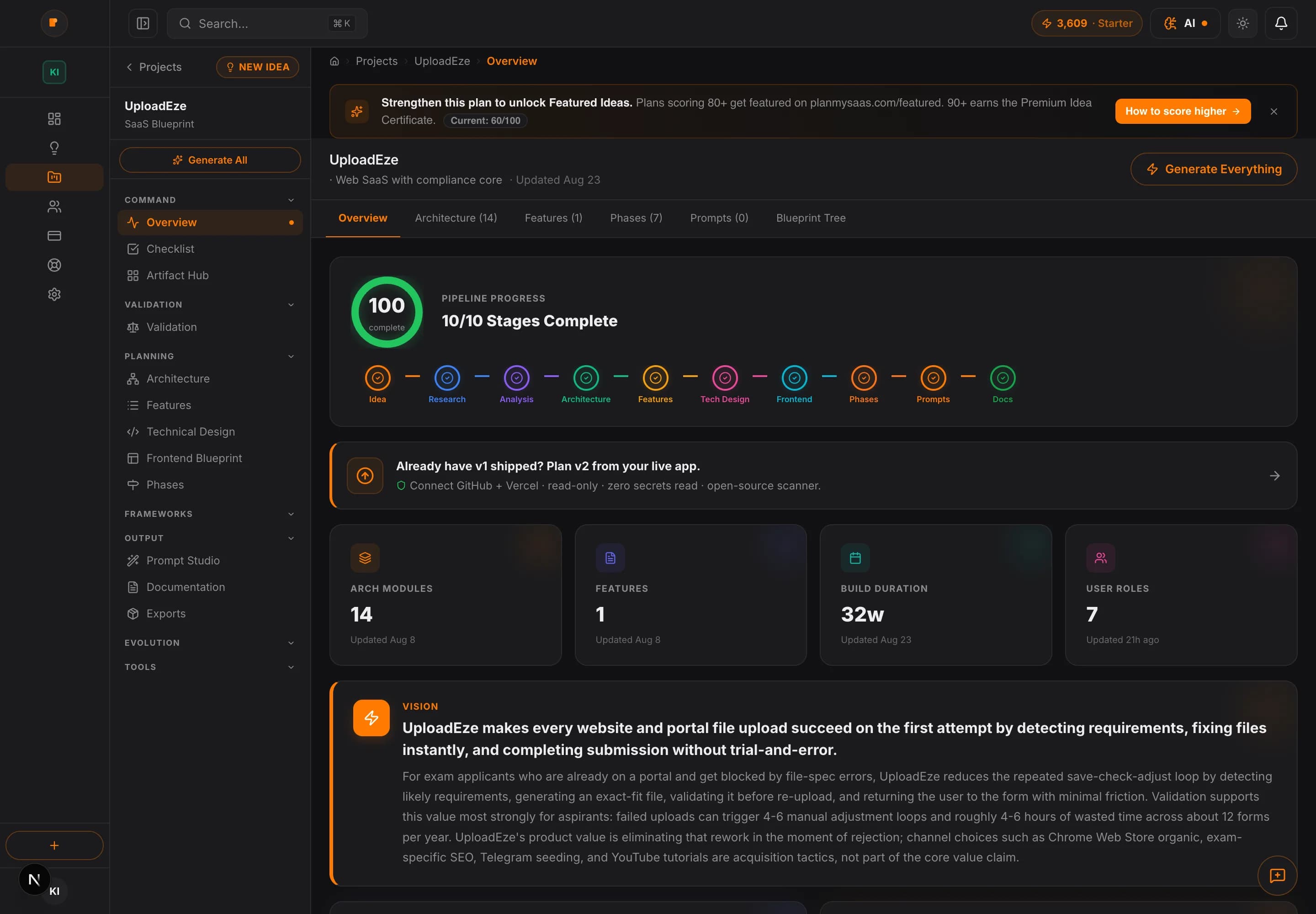
Build unlocks once the report is 50% complete. You do not need a positive verdict to promote — that is deliberate. A Reconsider verdict with a clear test in front of it is a legitimate reason to start planning a smaller first version.
What promoting does is carry the research forward. The project's architecture, features and technical design are generated with the validation findings as context, which is why a promoted project is sharper than one started from a blank description.